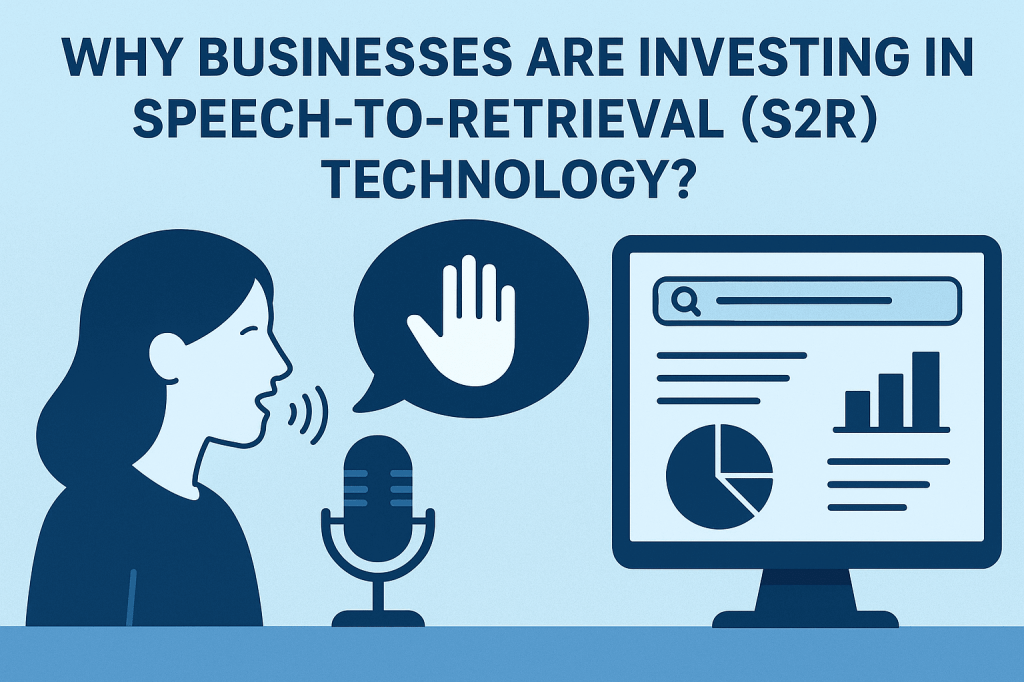
In the modern business landscape, organizations are inundated with vast amounts of information every day. While traditional data such as emails, documents, and spreadsheets are relatively easy to store and search, audio data like meetings, conference calls, and customer service recordings often remain underutilized. Speech-to-Retrieval (S2R) technology is revolutionizing how businesses manage this valuable audio content. By converting spoken words into searchable, structured data, S2R allows companies to access insights quickly, make informed decisions, and improve overall efficiency. Unlike conventional search methods that rely on typed queries, S2R understands spoken language, context, and intent, making it possible to extract precise information from hours of recordings without manual effort. As businesses strive to stay competitive, the adoption of S2R tools has become a strategic necessity. For those looking to explore the tools powering this transformation, see Speech-to-Retrieval tools.
Furthermore, the rise of hybrid and remote work has increased reliance on voice-based communication. Daily team discussions, client calls, and brainstorming sessions generate a significant volume of audio data. Without a way to efficiently process and retrieve information from these sources, critical insights can be lost, and decision-making can slow down. S2R technology bridges this gap by making audio data as accessible and actionable as text-based information. Businesses now have the opportunity to turn every meeting or conversation into a valuable source of intelligence that can drive growth, improve customer satisfaction, and reduce operational inefficiencies.
What is Speech-to-Retrieval (S2R) Technology?
Speech-to-Retrieval (S2R) technology is an advanced artificial intelligence solution that combines speech recognition, natural language processing (NLP), and information retrieval to convert spoken language into actionable data. In simple terms, it allows businesses to turn audio content from meetings, calls, podcasts, and voice notes into searchable text, enabling instant access to relevant information without manually reviewing hours of recordings.
Traditional search systems rely on typed keywords to locate information within documents or databases. However, these methods are not optimized for audio content. S2R overcomes this limitation by understanding human speech, including nuances, accents, and context, making it possible to extract precise insights from spoken language. This capability is particularly valuable for industries like customer service, healthcare, legal, sales, and marketing, where critical information often exists in audio format.
The working of S2R technology typically involves three major stages:
- Transcription: Advanced speech recognition algorithms automatically convert audio recordings into accurate text. This process involves detecting individual words, identifying speakers, and handling different accents or speech patterns.
- Analysis: Once transcribed, NLP algorithms analyze the text to understand context, intent, and meaning. This includes identifying key phrases, sentiment, and topics discussed in the conversation.
- Indexing and Retrieval: The processed text is indexed into a searchable database. Businesses can then perform queries in natural language or keywords to retrieve precise information quickly, saving time and reducing errors.
By combining these three stages, S2R technology ensures that businesses can access insights from audio data in a manner similar to text-based searches. Unlike manual transcription or listening to recordings, which are time-consuming and prone to error, S2R delivers accurate results efficiently, enabling employees to focus on higher-value tasks. Over time, the system can also learn and adapt to specific terminology, industry jargon, or company-specific language, further improving its effectiveness and relevance.
Moreover, S2R is not limited to just retrieval of information. When integrated with AI-driven analytics, it can provide deeper insights, such as customer behavior patterns, team collaboration efficiency, or compliance issues, turning raw audio data into a strategic business asset.
Key Benefits of S2R for Businesses
Speech-to-Retrieval technology offers multiple benefits that make it an essential tool for modern organizations. By transforming audio content into actionable data, businesses can improve efficiency, reduce costs, and gain strategic advantages. Below are the primary benefits of adopting S2R technology:
- Enhanced Accessibility: S2R allows employees to access insights from voice notes, meetings, and calls without needing to manually review recordings. For example, a project manager can quickly search for action items discussed in a team meeting from the previous week, saving hours of listening time. This ensures that critical information is always available when needed, improving productivity and decision-making.
- Improved Efficiency: By automating transcription, analysis, and retrieval, S2R significantly reduces the time employees spend searching for information. Support teams can instantly locate relevant customer interactions, sales teams can review client conversations without delays, and executives can extract key insights from multiple meetings in minutes. This efficiency allows employees to focus on high-value tasks that directly impact business growth.
- Cost Reduction: Manual transcription and data extraction are labor-intensive and costly, especially for organizations dealing with large volumes of audio data. Implementing S2R technology reduces reliance on human transcription, minimizes errors, and decreases operational costs. For example, call centers that record thousands of customer calls daily can save significant resources by automatically indexing and retrieving critical information using S2R.
- Better Customer Experience: Quick access to voice data enables support teams to respond to customer queries faster and more accurately. By analyzing audio interactions, companies can identify recurring issues, monitor sentiment, and proactively address concerns. For instance, analyzing call recordings can help identify service bottlenecks, enabling businesses to optimize processes and deliver a more seamless customer experience.
- Data-Driven Decision Making: Beyond retrieving information, S2R technology provides insights that guide strategic decisions. By analyzing trends in customer conversations, sales interactions, or team meetings, businesses can make informed choices about product development, marketing campaigns, and operational improvements. This transforms raw audio data into a valuable source of intelligence that drives growth.
- Scalability: As organizations grow, the volume of audio data increases. S2R technology scales easily, handling large datasets without compromising accuracy or speed. Unlike manual processes that become slower and more error-prone as data volume increases, S2R ensures consistent performance, making it suitable for businesses of any size or industry.
Real-World Use Cases
Customer Support
Customer support teams generate a significant volume of audio data from calls, chats, and voicemails every day. S2R technology allows businesses to transcribe these recordings automatically, making it easier to analyze and retrieve relevant information. For example, a call center can identify common customer complaints, monitor agent performance, and detect sentiment trends in real time. By quickly accessing insights from past conversations, support teams can provide faster resolutions, reduce call handling times, and improve overall customer satisfaction.
Sales and Marketing
Sales teams often rely on client calls, meetings, and presentations to gather information about customer needs and preferences. S2R technology enables them to transcribe these interactions and extract key insights, such as frequently mentioned challenges, product requests, or competitor information. Marketing teams can also analyze audio interactions to understand audience sentiment and identify trends, which can inform targeted campaigns and personalized messaging. By leveraging voice data, businesses can create more effective sales strategies and improve customer engagement.
Legal and Compliance
In the legal and compliance sectors, organizations must review large volumes of audio recordings, such as depositions, conference calls, or internal communications. S2R technology allows legal teams to search and retrieve relevant information quickly, reducing the time spent manually reviewing recordings. For instance, a compliance officer can locate specific discussions related to regulatory requirements or policy violations within minutes. This not only increases accuracy but also ensures that organizations meet legal and regulatory obligations efficiently.
Healthcare
Healthcare professionals often dictate patient notes, consultations, or treatment plans, which need to be accurately recorded and easily accessible. S2R technology transcribes these audio records and indexes them for quick retrieval, enabling doctors and nurses to access critical patient information instantly. For example, during a patient emergency, a doctor can search past consultation recordings to review medical history or previous treatment recommendations. This improves the quality of care, reduces administrative burden, and allows healthcare staff to focus more on patient outcomes.
Why Businesses Are Investing Now
The adoption of Speech-to-Retrieval technology has accelerated in recent years due to several converging factors. Businesses are increasingly realizing the value of voice data and the competitive advantage offered by S2R solutions. The following reasons explain why organizations are investing in this technology now:
- Rise of Remote and Hybrid Work: The global shift to remote and hybrid work models has increased the volume of voice-based communication. Meetings, team discussions, client calls, and virtual brainstorming sessions generate massive amounts of audio content daily. Without a way to efficiently process and retrieve information from these recordings, critical insights are at risk of being lost. S2R technology enables businesses to convert this audio into actionable data, ensuring that information remains accessible regardless of location.
- Advancements in Artificial Intelligence and NLP: Recent improvements in AI and natural language processing have made S2R systems more accurate and reliable. Modern algorithms can understand context, detect intent, and handle multiple accents or languages, making transcription and retrieval highly precise. This accuracy builds confidence among businesses that their investment will deliver meaningful results without the limitations of earlier technologies.
- Cost Efficiency: Organizations dealing with large volumes of audio data face significant costs for manual transcription, analysis, and storage. S2R automates these processes, reducing labor expenses, minimizing errors, and accelerating workflows. For example, call centers that handle thousands of calls daily can save thousands of hours and substantial operational costs by implementing S2R systems.
- Competitive Advantage: Businesses that adopt S2R technology gain an edge over competitors by making faster, data-driven decisions. They can uncover customer insights, detect trends, and respond proactively to market changes. Early adopters of S2R can leverage their audio data to improve customer experience, optimize internal processes, and develop innovative products or services that meet evolving market demands.
- Scalability and Future-Proofing: As companies grow, the volume of voice data naturally increases. S2R systems are scalable, capable of handling large datasets without compromising accuracy or speed. By investing in this technology now, organizations future-proof their operations, ensuring that they can manage increasing volumes of audio data efficiently.
- Integration with Existing Technologies: S2R can integrate seamlessly with other AI-driven tools, such as predictive analytics, CRM systems, and conversational AI platforms. This allows businesses to gain deeper insights from voice data and combine it with other datasets for more comprehensive decision-making. For insights into the future of this technology, see Speech-to-Retrieval.
Future of S2R Technology in Business
The future of Speech-to-Retrieval technology looks very promising as businesses continue to recognize the value of audio data. With ongoing advancements in artificial intelligence, natural language processing, and machine learning, S2R is expected to become even more accurate, intelligent, and widely adopted across industries. Here are some of the key trends and future developments:
- Integration with Predictive Analytics: S2R systems will increasingly integrate with predictive analytics tools, enabling organizations to not only retrieve past information but also forecast trends. For instance, sales teams could analyze customer calls to predict buying behavior, helping them tailor outreach and optimize conversions.
- Enhanced Context Understanding: Future S2R solutions will better understand context, sentiment, and intent within conversations. This will allow businesses to extract nuanced insights, such as customer emotions or the urgency of specific requests, providing a deeper understanding than simple keyword-based searches.
- Seamless Collaboration Across Platforms: S2R will become more integrated with collaboration tools like video conferencing, CRM systems, and cloud storage platforms. This will allow users to search and retrieve information from multiple sources in real time, improving productivity and reducing silos within organizations.
- Advanced Industry-Specific Applications: Different industries will benefit from specialized S2R applications. In healthcare, S2R could analyze doctor-patient conversations to flag potential health risks. In finance, it could review calls for compliance and fraud detection. In retail, it could monitor customer feedback to improve products and services. These targeted applications will make S2R even more indispensable.
- Voice-Activated Decision Making: As voice interfaces become more sophisticated, employees may interact directly with S2R systems to retrieve information or execute tasks using natural language commands. This will streamline workflows and make access to information faster and more intuitive than ever before.
- Global Adoption and Multilingual Support: With globalization, businesses require S2R systems capable of understanding multiple languages and regional accents. Future solutions are expected to offer multilingual support, allowing organizations to analyze voice data across different geographies seamlessly.
Overall, the future of S2R technology points toward greater intelligence, broader applicability, and deeper integration into business operations. Organizations that adopt S2R early will benefit from faster decision-making, more effective collaboration, and enhanced insights derived from audio data, positioning themselves for long-term growth and innovation.
Conclusion
Speech-to-Retrieval (S2R) technology has emerged as a transformative tool for modern businesses, enabling organizations to convert voice data into actionable insights efficiently. By providing enhanced accessibility, improving operational efficiency, reducing costs, and enabling data-driven decision-making, S2R is helping businesses unlock the full potential of their audio content. Companies can now leverage conversations, meetings, and customer interactions as a strategic asset rather than leaving them unutilized.
As organizations continue to adopt S2R, the benefits extend beyond simple retrieval of information. The technology allows for better customer experience, faster response times, and improved internal collaboration. Additionally, by integrating S2R with AI-driven analytics and predictive tools, businesses can gain deeper insights, anticipate trends, and make smarter decisions that drive growth.
Looking ahead, S2R is set to become even more intelligent and integrated across industries, with capabilities such as context understanding, sentiment analysis, voice-activated retrieval, and multilingual support. Early adoption of this technology provides businesses with a competitive edge, ensuring they remain agile and informed in an increasingly data-driven world. Companies seeking to explore advanced voice-based AI solutions and leverage the full potential of audio data can check out Conversational AI companies.
 Business Club
Leave a comment