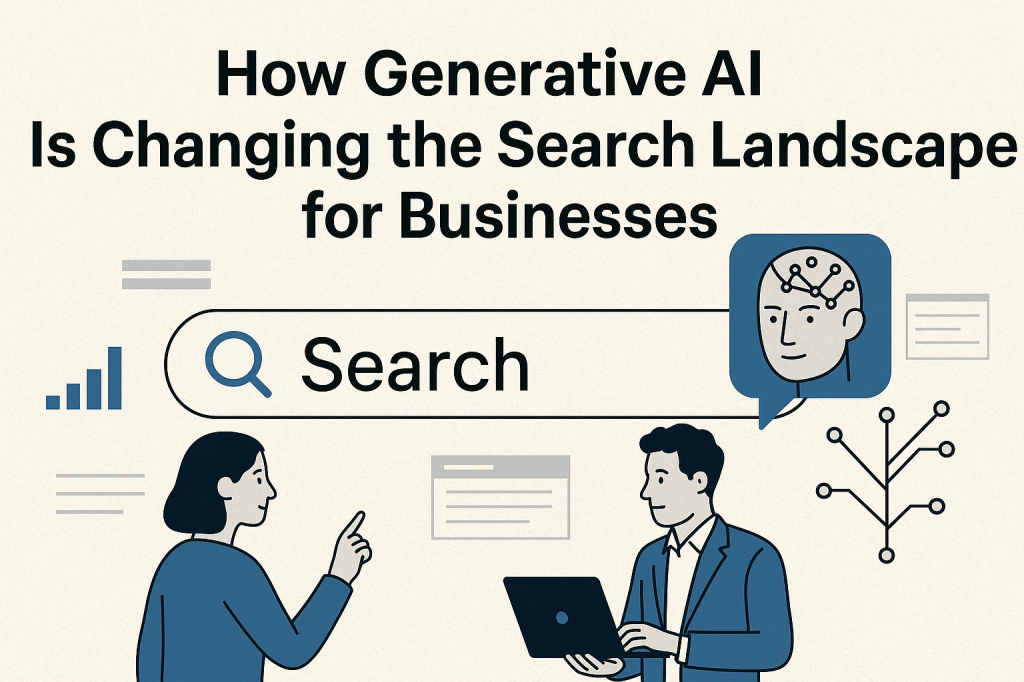
The way people search online is undergoing a major transformation, and generative AI is leading the change. Instead of relying solely on traditional keyword-based search results, users now get conversational, summarized answers from advanced AI systems. These responses are powered by language models that analyze vast amounts of data to deliver highly relevant results instantly.
For businesses, this shift presents both opportunities and challenges. While AI makes information more accessible to users, it also disrupts how companies attract attention, generate traffic, and convert visitors. Ranking on Google is no longer enough. Companies must now learn how to show up inside AI-generated responses that users trust.
This article explores how generative AI is redefining search behavior, what it means for online visibility, and how businesses can optimize their content for this new landscape.
What Is Generative AI Search?
Generative AI search refers to a new kind of search engine experience where artificial intelligence doesn’t just list links—it generates direct, conversational answers based on a user’s query. These answers are created using large language models (LLMs), such as those behind Google’s Search Generative Experience (SGE) or Microsoft’s Bing AI.
Instead of typing a keyword like “best running shoes” and getting a list of links, a user might now ask, “Which running shoes are best for trail runners with flat feet?” The AI understands the nuance and generates a detailed response that includes personalized recommendations, facts, and even pros and cons—all within seconds.
This type of search is built to save users time by providing deeper, contextualized responses. It pulls from multiple sources, identifies trustworthy content, and generates a human-like explanation without requiring users to visit several websites to piece together the information themselves.
For users, it means faster answers. For businesses, it means a shift in strategy: the goal is no longer just to appear in a list of links, but to be the source that AI selects when forming its answer.
Traditional vs. Generative Search
Traditional search engines like Google and Bing have long worked by indexing web pages and ranking them based on factors like keywords, backlinks, and domain authority. When a user searched for something, the engine returned a list of links that matched those keywords. Users had to click, scan, and sift through multiple pages to find the answers they needed.
Generative AI flips that model. Instead of providing a list of links, it synthesizes the most relevant and accurate information into a summarized answer. This answer appears directly in the search results and often satisfies the user’s need without any clicks.
This shift reduces organic traffic to websites because users don’t need to browse multiple sources. For businesses, it means the value of “ranking first” is declining. Now, being the source that AI draws from is more important than ever. It requires businesses to not only create quality content but also to format and structure it in ways that AI can easily understand and use in its summaries.
The Rise of AI-Powered Answer Engines
Search engines are rapidly evolving into “answer engines.” Rather than directing users to other websites, these systems aim to provide complete, accurate answers directly on the search page. Tools like Google’s Search Generative Experience (SGE), Microsoft’s Bing AI, and platforms like ChatGPT or Perplexity AI are now leading this transformation.
These engines use advanced language models to pull content from a variety of online sources, interpret the user’s intent, and then generate responses in a conversational tone. In many cases, users don’t even scroll past the AI-generated result—they trust the summary as the final answer.
For businesses, this means content must be optimized not just for human readers or search crawlers, but also for language models. These models decide which sources to include in their answers based on clarity, trustworthiness, and structure. If your content isn’t aligned with these expectations, it may never appear in the AI’s output—even if your page ranks high in traditional search results.
How User Search Behavior Is Changing
As generative AI becomes more common in search, people are adjusting how they interact with it. Instead of typing short, keyword-based queries like “best laptops 2025,” users are now asking complete questions such as “What are the best laptops for graphic design students in 2025 and why?”
This shift reflects a change in expectations. Users now assume the search engine will understand context, compare options, and give specific recommendations. They’re not just searching for links—they’re looking for personalized, conversational answers.
For businesses, this change is critical. To meet user expectations, your content must reflect natural language patterns. It should answer questions directly, cover variations of a topic, and use simple, conversational language that feels human and helpful.
What Is Generative Engine Optimization (GEO)?
Generative Engine Optimization, or GEO, is a modern approach to content strategy that focuses on making your content more accessible and favorable to generative AI systems. Unlike traditional SEO, which aims to boost rankings on a search engine results page, GEO is about making your content visible within AI-generated answers.
To succeed with GEO, your content must be highly structured, fact-based, and written in clear, natural language. Language models prefer content that’s easy to parse and confidently sourced. GEO also considers metadata, schema markup, and the overall authority of your site.
In short, GEO helps your business become the source that AI engines choose to feature in their summarized responses, driving indirect visibility and brand trust even if users never click through to your website.
SEO Isn’t Dead—It’s Evolving
With the rise of generative AI, many marketers wonder if traditional SEO still matters. The answer is yes—but it’s evolving. Traditional SEO practices like keyword optimization, backlinks, and mobile-friendly design are still essential. However, they now need to work alongside strategies tailored for AI-driven search experiences.
This evolution introduces new layers: Answer Engine Optimization (AEO) and Generative Engine Optimization (GEO). These approaches focus on making content readable and relevant for AI systems that generate direct answers. It’s no longer about ranking alone—it’s about being selected as a trusted source by AI.
Successful businesses will combine technical SEO foundations with AI-optimized content structures. This hybrid strategy will be key to visibility in both traditional and generative search environments.
Why Content Strategy Matters More Than Ever
In the age of generative AI, your content is either helping you get discovered or making you invisible. With AI pulling the most relevant, clear, and authoritative content to form direct answers, the way you write and structure content has become just as important as what you write about.
Long, unfocused articles no longer perform well. Instead, content should be concise, easy to scan, and built around specific questions or topics. AI prefers content that gets to the point, explains concepts clearly, and offers actionable insights. Every paragraph should serve a clear purpose.
Businesses that treat content like a strategic asset—focusing on clarity, trust, and user intent—will have a much higher chance of being cited by AI and noticed by users.
Impact on Business Visibility and Traffic
Generative AI is changing how people engage with content, and that directly impacts how businesses attract traffic. When AI gives users a full answer at the top of the page, there’s less need to click through to a website. This means even well-ranking pages may see a drop in organic traffic.
However, this doesn’t mean your brand has to lose visibility. If your content is used by AI to generate those top answers, your brand can still appear in front of your audience—just in a different way. Being referenced or cited within an AI summary can build authority and trust.
To stay visible, businesses need to monitor not just page rankings but also how and where their content appears in AI-driven responses. Visibility now depends more on content clarity, trust signals, and relevance than ever before.
Visual and Multimodal Content in AI Search
Generative AI isn’t limited to text. Modern search experiences are becoming multimodal, meaning they combine text, images, video, audio, and even interactive elements to deliver richer answers. Google’s AI Overviews, for example, might show a brief paragraph alongside a video or carousel of images.
For businesses, this means visual content is just as important as written content. Product images, explainer videos, infographics, and charts must be optimized with proper metadata, alt text, and descriptions. This helps AI understand and include them in its answers.
To stay competitive, brands must embrace a content strategy that supports multiple formats—not just blog posts or web pages.
Tracking Performance in an AI-Driven World
One of the biggest challenges with generative AI search is measurement. Traditional SEO tools like Google Analytics or Search Console aren’t designed to track how often your content is cited or summarized by AI. As a result, businesses need to rethink how they evaluate performance.
Instead of just monitoring clicks and rankings, focus on broader visibility metrics. These might include brand mentions in AI-generated answers, traffic from AI-powered platforms, or increased conversions from indirect exposure. Some tools and agencies now offer services to measure this emerging area, often referred to as “share of model.”
Staying visible means paying attention to where and how your content appears, even when users never land directly on your website.
How Businesses Can Adapt Now
Generative AI is reshaping search behavior fast, but businesses that act early can stay ahead. To adapt effectively, you need to rethink how your content is created, structured, and distributed. It’s not just about ranking anymore—it’s about being useful and easy for AI to understand.
- Refresh Existing Content: Update your most visited pages with clear formatting, simplified explanations, and current data. Focus on answering specific questions that users—and AI—might be looking for.
- Use Clear, Structured Formats: Break your content into smaller sections with headings, bullet points, and summaries. These formats are easier for AI to extract and display.
- Create FAQ and How-To Content: Direct, practical content is more likely to be featured in AI-generated responses. Add FAQs, definitions, and quick guides throughout your site.
- Implement Schema Markup: Use structured data to help AI understand the purpose of your content. Include things like product schema, article schema, and FAQ schema where relevant.
- Leverage Authoritative Sources: Include quotes, data, or insights from experts. Content that appears trustworthy is more likely to be selected by AI as a source.
Adapting your content to work with AI systems may take time, but it’s an essential move for long-term digital visibility and brand credibility.
Ethical and Accuracy Concerns
As powerful as generative AI is, it comes with serious ethical and accuracy concerns. One of the biggest issues is that AI models can sometimes produce incorrect or misleading information—commonly known as “hallucinations.” If AI misrepresents your brand, product, or data, it can harm your reputation without you realizing it.
Businesses must monitor how AI platforms reference their content and quickly correct misinformation. Additionally, transparency about data sources and authorship helps build trust—not just with users, but with AI systems themselves. Authoritative content tends to be favored by models trained to detect credibility.
There’s also a growing conversation around the environmental impact of AI, particularly the high energy consumption of large-scale model training. Companies should be mindful of their AI use and consider how their digital strategies align with sustainability goals.
The Role of Generative Engine Optimization Agencies
As the search landscape shifts toward generative AI, many businesses find it challenging to keep pace with evolving visibility requirements. That’s where Generative Engine Optimization (GEO) agencies come into play. These specialized firms help companies optimize their content so that AI systems—such as Google’s SGE, Bing AI, or ChatGPT—can easily identify and surface it within generated responses.
GEO agencies combine deep knowledge of AI behavior with SEO best practices. They audit your content for structure, clarity, trustworthiness, and technical markup. Their aim is to boost your “share of model”—how often your brand or content is featured in AI-generated answers—even if users never click through to your site.
Partnering with a GEO agency can be a strategic move for businesses that want to stay visible and credible in a future where AI systems increasingly control what users see.
Conclusion
Generative AI is redefining how users search, how content is delivered, and how businesses stay visible online. Instead of chasing rankings alone, companies must now think about how their content fits into AI-generated answers. This requires a shift in strategy—one that focuses on clarity, credibility, and structured information.
Brands that act now will be better prepared for the future. Whether through restructured content, technical optimization, or expert support, businesses must evolve to stay relevant in this AI-powered search ecosystem.
For companies seeking expert guidance, partnering with one of the top Generative Engine Optimization Agencies can provide the strategic support needed to thrive in this new era of search
 Business Club